If you own solar in California or you’re planning to, you’ve probably heard that NEM 3.0 (the Net Billing Tariff) lowered midday export credits. That change makes a home battery useful not just for backup, but for shifting energy from low‑value hours to high‑value hours—also known as Time‑of‑Use (TOU) arbitrage. This beginner’s guide shows you how it works, the three numbers you need, and a simple way to estimate savings so you can talk confidently with an installer.
Note: Rates and policies are current as of Feb 2026. Always verify your specific plan’s tariff PDFs and export credit references before making decisions. This guide is educational and not financial advice.
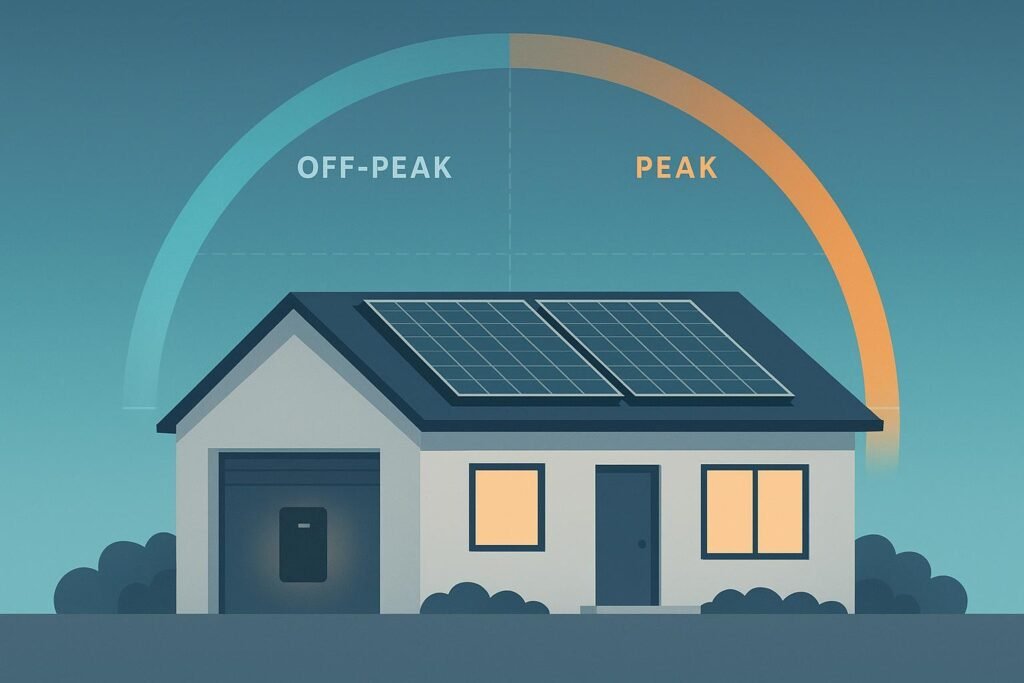
The three numbers you need before you estimate savings
You don’t need a spreadsheet to get started, but you do need three facts you can confirm in about 15 minutes.
1) Your utility’s TOU plan and peak/off‑peak hours
- PG&E: Peak is 4–9 p.m. daily on E‑TOU‑C. See the official plan document in the PG&E E‑TOU‑C tariff PDF for precise hours and current charges. Source: the PG&E schedule in the E‑TOU‑C tariff PDF.
- SCE: Residential TOU‑D options commonly use 4–9 p.m. or 5–8 p.m. peaks depending on the option and season. Confirm the exact hours for your active option via SCE’s rate pages and current tariff PDFs. Start with the SCE residential TOU plan overview.
- SDG&E: Many plans (e.g., TOU‑DR1) include On‑Peak 4–9 p.m., plus Off‑Peak and Super Off‑Peak periods. Verify the latest hours and seasons on the SDG&E “When Matters” page and the live tariff PDF for your plan.
Tip: Don’t rely on screenshots—TOU windows can change. Always open the current PDF for your exact plan.
2) How export credits work under NEM 3.0
Under NEM 3.0, your exported solar earns hourly credits derived from the CPUC’s Avoided Cost Calculator (ACC). Midday credits are often lower; evening credits can be higher. The mechanics are described in the CPUC’s documentation; see the 2024 ACC documentation and the CPUC DER cost‑effectiveness hub. For estimating, you only need to recognize that value varies by hour and season.
3) Your household’s evening usage (kWh) during peak
Look up your smart‑meter interval data or monthly usage chart to estimate how many kilowatt‑hours you typically use in peak windows (often 4–9 p.m.). If you don’t have exact interval data, a rough estimate is fine for a first pass; you’ll refine it with your installer.
How home battery TOU arbitrage in California works under NEM 3.0
Think of your battery as a time machine for electricity. You “store” energy when prices (and export credits) are low and “spend” it when prices (or export credits) are higher. Under NEM 3.0, this often means charging from midday solar or off‑peak grid hours and discharging from 4–9 p.m.
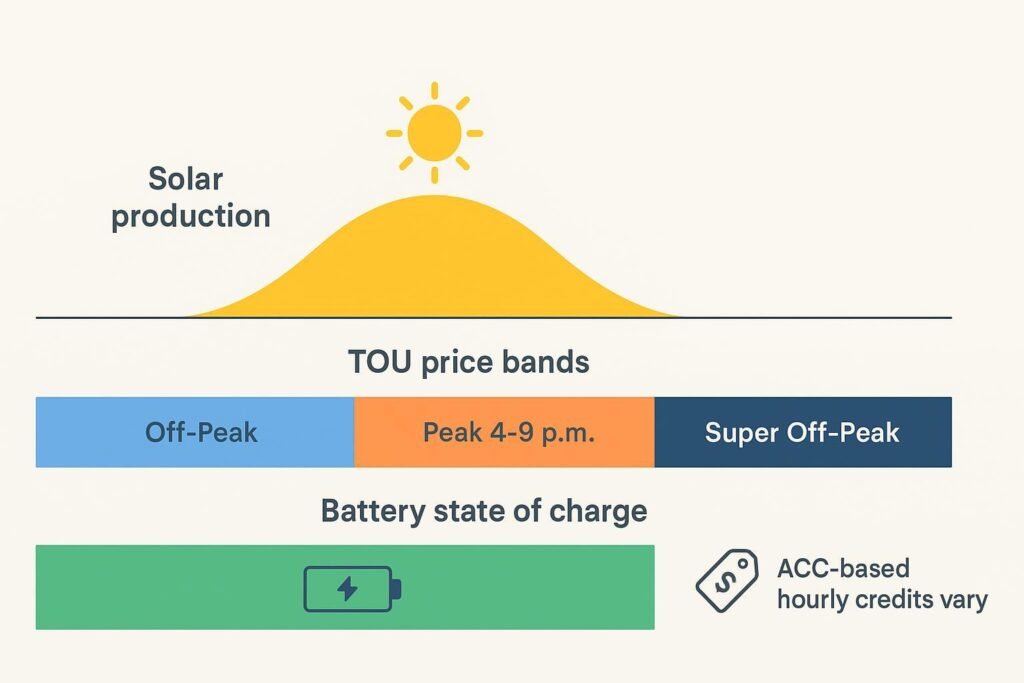
What changes the math under NEM 3.0 is that export credits no longer match retail import prices. They’re set hourly using the ACC, which means midday exports are usually worth less than evening energy. By discharging during peak hours, you avoid high‑priced imports and may direct your solar to higher‑value hours rather than exporting it at midday.
A simple way to estimate savings (beginner‑friendly)
We’ll keep it conservative and simple. You’ll plug in a few numbers you gathered above and do quick math.
Assumptions to set with your installer later: usable battery capacity (kWh), round‑trip efficiency (~90–95%), your TOU peak/off‑peak price difference, and a sense of export credit patterns for your utility.
Back‑of‑envelope formula (daily):
Daily arbitrage value ≈ (kWh discharged during peak × retail peak price)
                     − (kWh charged from grid × off-peak price)
                     + (kWh shifted from low-credit hours to high-value hours × credit uplift)
Worked example (illustrative only):
- Suppose you have a ~10 kWh usable battery and target covering 8 kWh of your 4–9 p.m. usage. If your off‑peak price is materially lower than peak, and midday export credits are typically lower than evening value, your battery can avoid several kWh of expensive imports during peak and shift solar from low‑credit midday to higher‑value evening hours. Because exact cents/kWh and export credits change, confirm numbers in your utility’s live tariff PDFs and ACC‑based references before relying on any estimate.
This simple savings frame is the core of home battery TOU arbitrage in California: charge low, discharge high, and increase self‑consumption when midday export credits are relatively low.
California micro‑case studies (illustrative)
These sketches use 4–9 p.m. peaks where applicable and keep numbers qualitative to avoid quoting stale cents/kWh. Check the linked official pages for current values.
PG&E (E‑TOU‑C)
On PG&E’s E‑TOU‑C, peak runs 4–9 p.m. daily. If your evening usage is, say, 6–10 kWh, a 10–13.5 kWh battery can be scheduled to discharge through most of that peak window. The value comes from avoiding imports at peak retail prices and reserving some midday solar in the battery rather than exporting it for lower midday credits. See PG&E’s official E‑TOU‑C tariff PDF for hours and rate components.
SCE (TOU‑D variants)
SCE offers TOU‑D options commonly centered on 4–9 p.m. or 5–8 p.m. peaks (some options vary by season or weekday). A homeowner targeting 5–8 kWh of evening usage could schedule discharge to overlap the full peak window. Verify your exact TOU‑D option and hours on the SCE residential TOU overview, then pull the live tariff PDF before calculating.
SDG&E (TOU‑DR family)
Many SDG&E plans include On‑Peak 4–9 p.m., with Off‑Peak and Super Off‑Peak periods. Batteries can charge from midday solar or super off‑peak and discharge through the 4–9 p.m. peak to avoid high retail prices while making better use of your own solar. Confirm your plan’s current hours and seasons via SDG&E’s When Matters page and the associated tariff PDF.
A neutral micro‑example using HDX Energy
Disclosure: HDX Energy is our product.
A first‑time homeowner with a 10 kWh LiFePO4 home battery wants to cover most of the 4–9 p.m. window. They schedule “charge preference” for midday solar and allow supplemental off‑peak charging if the battery isn’t full by late afternoon. The evening discharge target is set to hold a minimum reserve for overnight needs. This approach reduces peak imports and increases the value of self‑consumed solar under NEM 3.0.
Right‑sizing the battery and day‑to‑day operation
Size to your evening usage first, then consider backup goals. If you typically use 6–8 kWh between 4 and 9 p.m., a 10–13.5 kWh battery often covers that window with some margin for reserves, round‑trip losses, and partial winter solar. If whole‑home backup is also important, you may size up or configure critical‑load circuits to stretch runtime.
Operationally, most homeowners set: (1) a charging preference for midday solar or off‑peak; (2) a discharge window aligned with peak; and (3) a reserve percentage to keep some energy for late‑night or backup. Efficiency, depth‑of‑discharge limits, and inverter power (kW) all affect how far and how fast the battery can carry your home during peak—your installer will match settings to your priorities.
Installer checklist (use this to get apples‑to‑apples quotes)
- Your IOU and current TOU plan name, with a link to the live tariff PDF
- Estimated evening kWh during peak (e.g., 4–9 p.m.) from smart‑meter data
- Desired coverage: critical loads vs. whole‑home during peak and for backup
- Target battery size (kWh usable) and any preferred reserve percentage
- Confirmation that the system/inverter meets UL 9540/1973/1741 and local AHJ requirements
- NEM 3.0 export‑credit assumptions the installer uses and how schedules are set
- SGIP status: whether you may qualify for Residential Storage & Solar Equity and how to apply via SelfGenCA
For SGIP updates and budget availability, check the official portal’s announcements on SelfGenCA and, for the 2025 program expansion context, see the CPUC’s news release announcing $280 million for the Residential Storage & Solar Equity program (2025). Program rules and budgets can change; always verify the latest status.
Safety and certifications (what permits and insurers expect)
California jurisdictions generally look for UL‑listed systems and code‑compliant placements. Residential systems are typically listed to UL 9540 at the system level, with batteries evaluated under UL 1973 and inverters to UL 1741; UL 9540A testing is often referenced for fire‑safety and spacing considerations in NFPA 855 and building codes. For background, see UL’s overview of energy storage system testing and certification and state workshop materials hosted by energy agencies.
Many homeowners also ask about chemistry: modern LiFePO4 batteries are known for stable thermal behavior and long cycle life when properly engineered and certified. Regardless of brand, verify listings, installation clearances, and local permitting notes with your installer and Authority Having Jurisdiction (AHJ).
Resources and next steps
- CPUC sources on export credits and the ACC: DER cost‑effectiveness hub and the 2024 ACC documentation
- Utility TOU periods and tariffs: PG&E E‑TOU‑C tariff PDF; SCE residential TOU overview; SDG&E When Matters (TOU) page
Want help configuring time‑based control for arbitrage? See our brief walkthrough on HDX Energy.
Small‑print notes
- Policies and prices change. Always rely on your live tariff PDFs and current ACC‑based export credit references.
- This guide is informational and not financial advice; consult your utility, installer, and local permitting authority for specifics.