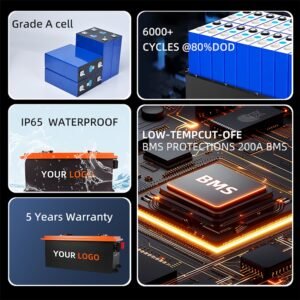
Lithium iron phosphate batteries (LiFePO₄ or LFP) are rapidly becoming the preferred choice for home energy storage. Whether you’re backing up critical loads, increasing solar self-consumption, or preparing for grid outages, a properly designed and installed LiFePO₄ system can deliver safe, long-lasting, and highly efficient power.
This guide walks you step by step through everything you need to know before installing LiFePO₄ batteries in your home:
What LiFePO₄ batteries are and how they differ from other chemistries
How to choose the right capacity and configuration
Safety, codes, and standards that apply to home installations
Practical installation steps (from siting to wiring and commissioning)
Maintenance, monitoring, and common troubleshooting issues
Cost, ROI, and typical payback considerations
Frequently asked questions from a professional installer’s perspective
Note: This guide focuses on stationary home storage (not RVs/boats), with an emphasis on typical residential systems in the ~5–40 kWh range.
1. Understanding Lithium Iron Phosphate (LiFePO₄) Batteries
1.1 What Is a LiFePO₄ Battery?
A LiFePO₄ battery is a type of lithium-ion battery that uses lithium iron phosphate (LiFePO₄) as the cathode material. Compared with other lithium-ion chemistries, LiFePO₄ is:
More thermally stable
More tolerant to abuse (overcharge, overheating)
Longer-lasting in terms of cycle life
Typically safer, with a very low risk of thermal runaway when properly designed and managed
Each cell typically has a nominal voltage of ~3.2–3.3 V. Cells are combined in series and parallel to produce higher system voltages and capacities.
1.2 LiFePO₄ vs Other Battery Technologies
When considering a home energy storage system (HESS), most homeowners compare LiFePO₄ to:
Below is a comparison table using typical 2023–2024 values:
Table 1 – Comparison of Common Home Battery Types (Typical Values)
Parameter
Lead-Acid (AGM/Gel)
NMC / NCA Lithium-Ion
LiFePO₄ (LFP)
Typical Cycle Life (80% DoD)
500–1,200 cycles
2,000–4,000 cycles
3,000–8,000+ cycles
Usable DoD (Daily Use)
50–60%
80–90%
80–100% (often 90–95% recommended)
Round-Trip Efficiency
75–85%
90–95%
92–98%
Energy Density (Wh/kg)
30–50
150–250
90–160
Typical Operating Temp Range
0–40 °C (32–104 °F)
-10–45 °C (14–113 °F)
-20–55 °C (-4–131 °F)
Safety / Thermal Runaway
Moderate (gas release)
Higher risk (needs tight BMS)
Very low risk with proper BMS
Maintenance
Periodic (for flooded)
Low
Very low
Upfront Cost per kWh (Battery)
Low
High
Medium-high (falling quickly)
Environmental Impact
Lead recycling critical
Uses cobalt/nickel (varies)
Cobalt-free, iron/phosphate-based
Values are ranges based on recent industry data through 2024; exact specifications depend on brand and model.
Key takeaway: For home storage, LiFePO₄ offers an attractive combination of safety, longevity, and efficiency, often at a total lifecycle cost that is competitive or better than alternatives.
2. Why Choose LiFePO₄ for Home Energy Storage?
2.1 Safety Advantages
Safety is the most critical factor in any residential battery installation. LiFePO₄ has:
High thermal stability: The iron-phosphate chemistry is inherently more stable.
Low risk of oxygen release: Reduced likelihood of self-fueling fires compared to some other lithium chemistries.
Lower risk of thermal runaway: Still requires a quality BMS and correct installation, but overall risk is significantly lower.
This is why many reputable home battery brands are switching to or offering LiFePO₄ options.
2.2 Long Cycle Life
LiFePO₄ can routinely reach:
3,000–6,000 cycles at 80% depth of discharge (DoD)
Some premium systems claim 6,000–10,000 cycles under optimal conditions
For a daily cycle, 3,000 cycles equates to over 8 years; 6,000 cycles to over 16 years of operation. This long cycle life can more than justify the initial investment when used regularly in grid-tied or solar-plus-storage systems.
2.3 High Usable Capacity and Efficiency
LiFePO₄ batteries typically allow:
80–100% DoD (manufacturers often recommend ~90% for optimal life)
Round-trip efficiencies of 92–98% under typical loads
This means you can use more of the nameplate capacity and lose less energy to heat and internal resistance, which improves both operational performance and economic returns.
2.4 Environmental and Regulatory Considerations
LiFePO₄ batteries:
Are cobalt-free, avoiding the ethical and environmental concerns associated with cobalt mining.
Use materials (iron, phosphate, lithium) that are more abundant and increasingly recyclable.
Are increasingly supported by international safety standards (e.g., UL, IEC) and are widely accepted by permitting authorities in many regions.
3. Planning a Home LiFePO₄ Battery System
Before you buy or install anything, planning is critical. A well-designed system should align with:
Your energy goals (backup power vs. bill savings vs. full off-grid)
Your home’s electrical infrastructure
Relevant codes and standards
The physical space and environmental conditions of your site
3.1 Define Your Primary Use Case
Common residential use cases:
Backup power only
Battery charges from the grid (and/or solar) and discharges during outages.
Focus on reliability, surge capability, and integration with critical loads.
Solar self-consumption and time-of-use (TOU) arbitrage
Battery stores excess solar or cheap off-peak grid power; discharges during peak-rate times.
Emphasis on cycle life, efficiency, and smart control algorithms.
Partial off-grid (“grid-assisted”)
Battery plus solar system designed to minimize grid usage but still connected.
Requires robust inverter/charger and thoughtful sizing.
Full off-grid
Complete independence from the utility.
Requires careful sizing, redundancy, and attention to seasonal variations.
Your use case strongly affects battery sizing and inverter choice.
Avoid or minimize high-draw loads if budget is limited (e.g., electric ovens, AC, EV charging).
Calculate daily energy consumption (kWh per day) for those loads.
Determine autonomy (how many hours/days you need to run during an outage).
Apply a safety factor (typically 10–30%) for inefficiencies and growth.
Example Calculation
Assume critical loads consume 4 kWh per day and you want 2 days of autonomy:
Required energy = 4 kWh/day × 2 days = 8 kWh
Assume 90% usable DoD and 95% round-trip efficiency:
Effective usable fraction ≈ 0.90 × 0.95 ≈ 0.855
Required nominal battery capacity:
8 kWh / 0.855 ≈ 9.4 kWh
You might choose a 10 kWh LiFePO₄ battery in this scenario.
3.3 Matching the Battery to Your Inverter
Home storage systems typically use:
Hybrid inverters (solar + battery) or
Separate inverter/chargers + PV inverters or
All-in-one battery units with integrated inverters
Key considerations:
Voltage compatibility:
Many LiFePO₄ home systems are 48 V nominal (16 cells in series, 16S).
Some newer high-voltage systems use 100–600 V DC battery stacks.
Communication protocols:
CAN, RS485, Modbus, or proprietary protocols for SOC, voltage, and BMS warnings.
Many inverters need compatible BMS communication for full warranty coverage.
Power rating:
Continuous and surge (peak) power must handle your load.
Example: a 5 kW inverter with 10 kW surge for 10 seconds for starting motors.
Check manufacturer compatibility lists. Using battery brands and inverters that are officially listed as compatible simplifies configuration and warranty issues.
3.4 Considering Local Codes and Regulations
Regulatory requirements vary by country and region. As of 2023–2024, typical references include:
Electrical codes (e.g., NFPA 70 / NEC in some regions)
Fire codes and energy storage system guidelines
Certification standards:
UL 9540 (Energy Storage Systems)
UL 1973 / IEC 62619 (stationary battery safety)
National or regional building/fire codes
Common regulatory themes:
Limits on total energy capacity inside dwellings (e.g., 20–40 kWh per “fire area” in some jurisdictions; check local rules).
Requirements for clearances, ventilation, enclosures, and fire-resistance.
Restrictions on installing batteries in sleeping rooms or certain interior spaces.
Always consult:
A local licensed electrician
Your authority having jurisdiction (AHJ) or permitting office
The battery and inverter manufacturers’ installation manuals
4. Choosing Your LiFePO₄ Battery Components
4.1 All-in-One vs. Modular Batteries
You can choose between:
All-in-one home battery systems
Examples (conceptually): cabinet-style systems that include cells, BMS, and sometimes an inverter.
Cons: Higher upfront cost per kWh, less flexible for DIY expansions.
Modular rack-mounted LiFePO₄ batteries
48 V rack units (e.g., 5–15 kWh each) you can stack in a cabinet.
Pros: Flexible capacity, easier to service, often lower cost per kWh.
Cons: More wiring, slightly more complex installation.
DIY battery packs from cells (e.g., prismatic LiFePO₄ cells)
Highest flexibility and often lowest raw cost.
Requires specialized knowledge for safe design and assembly, plus compliance with local codes.
Warranties and inspections may be more challenging.
If you want a code-compliant, low-hassle solution with strong warranty support, an all-in-one or modular rack system from reputable manufacturers is usually the best choice.
4.2 Key Specifications to Compare
When comparing LiFePO₄ batteries:
Nominal capacity (kWh) and usable capacity (kWh at recommended DoD)
Nominal voltage (e.g., 48 V for low-voltage systems)
Continuous and peak charge/discharge current
Cycle life at specified DoD (e.g., 6,000 cycles at 80% DoD)
Round-trip efficiency (%)
Operating temperature range (charge and discharge)
Certifications (UL, IEC, regional standards)
Warranty: length (years), throughput (MWh), and conditions
4.3 Typical Market Prices (Approximate)
Prices vary by brand, region, and configuration. As of 2023–2024, indicative ranges for battery-only (excluding inverter and installation) are:
Table 2 – Approximate LiFePO₄ Home Battery Price Ranges (2023–2024)
System Size (Nominal)
Type
Typical Price Range (Battery Only)
Notes
5 kWh
48 V rack module
~US1,600–US2,500
~US320–US500 per kWh
10 kWh
Rack or wall-mount
~US3,000–US5,000
Volume discounts possible
15–20 kWh
Cabinet or multi-module
~US4,500–US8,000
Often includes BMS & monitoring
30–40 kWh
Larger cabinet or stacked
~US7,500–US14,000
More common in small commercial/off-grid
These ranges are illustrative, based on market observations through late 2024. Always obtain current quotes from suppliers.
5. Safety, Location, and Environmental Considerations
5.1 Choosing the Battery Location
Ideal characteristics for a battery location:
Cool, dry, and well-ventilated
Minimal exposure to direct sunlight, dust, and corrosive atmospheres
Away from flammable materials and high-traffic areas
Accessible for maintenance and inspection
Common locations:
Utility rooms
Garages (with code-compliant mounting and fire separation where required)
Dedicated battery rooms or enclosures
Outdoor-rated enclosures on an exterior wall (where allowed by local regulations)
Locations often discouraged or prohibited:
Bedrooms or sleeping areas
Closets or confined unventilated spaces
Areas exposed to flooding or excessive moisture
5.2 Temperature and Ventilation
LiFePO₄ batteries perform best at moderate temperatures:
Typical recommended operating range: 0–40 °C (32–104 °F) for charging
Discharge may be allowed down to -20 °C (-4 °F) depending on the model
Charging below 0 °C is usually limited or prohibited without special heating; BMS will typically prevent it.
For long life:
Try to maintain ambient temperatures around 15–30 °C (59–86 °F).
Consider climate control or passive cooling in hot climates and insulation or heating in cold climates.
Even though LiFePO₄ does not off-gas under normal operation, enough ventilation should be provided to:
Dissipate heat from electronics and inverters
Reduce risk in case of rare fault or failure
Meet code requirements for electrical equipment rooms
5.3 Mounting and Mechanical Considerations
Common approaches:
Wall-mounted units with manufacturer-specified brackets
Floor-standing cabinets or racks bolted to the floor
Seismic restraints in earthquake-prone regions
Always follow manufacturer instructions for:
Mounting orientation (vertical/ horizontal)
Clearances from walls, ceilings, and other equipment
Weight support and structural requirements
A fully populated cabinet can weigh hundreds of kilograms, so make sure the supporting structure is adequate.
6. Electrical Design Basics for LiFePO₄ Home Systems
6.1 System Topologies
Typical configurations:
AC-coupled systems
Solar PV connected to the main panel via a grid-tied inverter.
Battery connected through a separate hybrid inverter or battery inverter.
Pros: Flexible for retrofits, can mix and match components.
Cons: Extra conversion steps can reduce efficiency slightly.
DC-coupled systems
Solar panels feed a hybrid inverter/charger that directly charges the battery DC bus.
Pros: Higher efficiency, better control of battery charging.
Cons: Less flexible in some retrofits, more dependent on a single unit.
All-in-one energy storage systems (ESS)
Integrated unit: battery + inverter + BMS and control.
Pros: Simplest to install and configure; often well-supported by AHJs.
Cons: Higher cost and reliance on single vendor ecosystem.
6.2 Voltage and Current Considerations
Most residential LiFePO₄ systems are either:
Low voltage (LV): 48 V nominal (typically 16S LiFePO₄)
High voltage (HV): 100–600 V nominal, achieved by stacking multiple modules
LV systems:
Safer in terms of shock risk; widely used in small to medium residential systems.
Higher currents for the same power, requiring thicker cables and careful design.
HV systems:
Lower currents at the same power, allowing smaller cables and higher power output.
More stringent safety and design requirements; often used in larger systems or integrated commercial products.
6.3 BMS (Battery Management System) Role
The BMS is critical for:
Cell balancing (prevents individual cells from over/undercharging).
Over-voltage / under-voltage protection.
Over-current protection (charge and discharge).
Temperature monitoring and cutoffs.
Communication with inverters and monitoring devices.
For home systems, choose batteries with:
Integrated BMS that is certified and compatible with your inverter.
Clear documentation and a proven record of reliability.
6.4 Protection Devices and Disconnects
Key protective elements:
DC fuses or circuit breakers between battery and inverter
DC disconnect switch (often lockable) for maintenance
Surge protection devices (SPD), especially in lightning-prone areas
Grounding and bonding according to local electrical codes
Never rely solely on software-based protection; physical overcurrent protection is mandatory.
7. Step-by-Step Installation Process (High-Level)
Warning: Working on electrical systems, especially those involving battery banks and inverters, can be dangerous. Many jurisdictions require installations to be performed or supervised by a licensed electrician. Always follow local laws, codes, and manufacturer instructions.
In many markets, a 10–15 kWh LiFePO₄-based home storage system, fully installed, commonly falls into a US8,000–US18,000 range as of 2023–2024, depending heavily on region and brand.
11.2 Value Streams
Your LiFePO₄ system can generate value via:
Backup power: avoids costs of spoiled food, lost work, or critical downtime.
Solar self-consumption: stores excess PV instead of exporting at low feed-in tariffs.
Time-of-use arbitrage: reduces bills by shifting consumption from high to low tariff periods.
Demand charge management (in some regions): reduces peak demand and associated charges.
Quantifying ROI requires:
Your local electricity tariffs (peak vs off-peak).
You save US$0.20 per kWh through TOU arbitrage and self-consumption.
Annual savings ≈ 8 kWh/day × 365 days × US0.20≈US584
Simple payback ≈ US10,000/US584 ≈ 17.1 years
If your energy price differential is higher, or you also factor in backup value, incentives, or tax credits, the payback can be shorter. Always recalculate with current local data.
12. Future Trends and Technology Developments
As of late 2024, notable trends include:
Falling LiFePO₄ cell prices due to large-scale EV and stationary storage production.
Higher energy densities in new LiFePO₄ cell formats.
More all-in-one ESS units with integrated inverters, BMS, and smart controls.
Enhanced grid services (e.g., virtual power plant participation) where utilities reward homeowners for allowing limited control of their batteries.
Increasing emphasis on recycling and second-life applications for residential batteries.
These trends suggest that LiFePO₄ home systems will continue to become more affordable, capable, and integrated into the broader energy ecosystem.
13. Summary: Key Takeaways
LiFePO₄ batteries are currently one of the safest and most durable options for home energy storage.
Proper planning, sizing, and component selection are crucial for a successful installation.
Always adhere to local electrical and fire codes, and strongly consider using a licensed electrician.
Environmental conditions (temperature, location, ventilation) greatly influence performance and lifespan.
With correct charge settings, monitoring, and maintenance, LiFePO₄ systems can operate reliably for a decade or more of daily cycling.
If you’re considering a system for your own home, your next step is to:
Gather your recent electricity bills,
List your critical loads, and
Speak with a qualified installer who is experienced with LiFePO₄ technology.
14. Professional FAQ: Installing LiFePO₄ Batteries in Homes
Q1: Are LiFePO₄ batteries safe to install inside my home?
LiFePO₄ is among the safest lithium chemistries due to its thermal stability and low risk of thermal runaway. That said:
Installations must comply with local electrical and fire codes.
Many regions limit the total kWh you can install inside living spaces.
Batteries should be placed in a dedicated area with proper clearances and ventilation.
Consult a qualified electrician and your local authority to determine acceptable locations and capacity limits.
Q2: How long will a home LiFePO₄ battery system last?
Most quality LiFePO₄ systems:
Advertise 3,000–6,000 cycles at 70–80% DoD.
Offer warranties of 8–15 years, often with energy throughput limits.
In residential applications with one cycle per day, it is realistic to expect 10+ years of useful life if:
The system is sized appropriately,
Operated within recommended temperature ranges, and
Properly installed and configured.
Q3: Can I install LiFePO₄ batteries myself?
Technically, skilled DIY enthusiasts can install LiFePO₄ batteries—especially modular systems—but there are important caveats:
Many jurisdictions require licensed electricians for permanent home electrical work.
Incorrect installation can cause safety hazards or void warranties.
Permits and inspections may be needed for legal and insurance reasons.
For most homeowners, the safest path is to work with a licensed, experienced installer who is familiar with LiFePO₄ systems and local codes.
Q4: Can LiFePO₄ batteries work with my existing solar panels?
Yes, in most cases:
If you have a hybrid inverter or can install one, LiFePO₄ batteries can be DC- or AC-coupled to your PV array.
For existing grid-tied systems with standard PV inverters, you can add a separate battery inverter and configure an AC-coupled system.
You’ll need to ensure compatibility between battery, inverter, and any existing equipment. Many manufacturers publish compatibility lists and recommended wiring diagrams.
Q5: How should I size my LiFePO₄ battery for backup vs solar savings?
For backup power:
Start with your critical loads and desired outage duration (e.g., 1–2 days).
Add 10–30% extra capacity for losses and future growth.
For solar self-consumption and bill savings:
Analyze your solar production vs consumption profile.
A common rule of thumb is to size the battery at 1–2× your average daily excess solar or enough to cover your typical evening peak usage.
A professional installer can run simulations based on your actual meter data for a more accurate sizing.
Q6: Is LiFePO₄ better than other lithium batteries for home use?
For most residential applications, LiFePO₄ offers an excellent balance of:
Safety
Cycle life
Cost per cycle
Environmental profile (no cobalt)
Some higher-density chemistries (like NMC) may offer more compact designs but generally come with higher thermal runaway risk and sometimes shorter cycle life. As a result, many manufacturers and installers increasingly prefer LiFePO₄ for stationary home storage.
Q7: What happens to my LiFePO₄ battery at the end of its life?
At end of life, LiFePO₄ batteries:
Usually still retain 60–80% of their original capacity (depending on usage), making them candidates for second-life applications with lower performance needs.
Contain materials (lithium, copper, aluminum, iron, phosphate) that can be recycled.
Recycling infrastructure for lithium batteries is expanding globally. Check with your installer, manufacturer, or local waste authority for responsible disposal or recycling programs in your area.